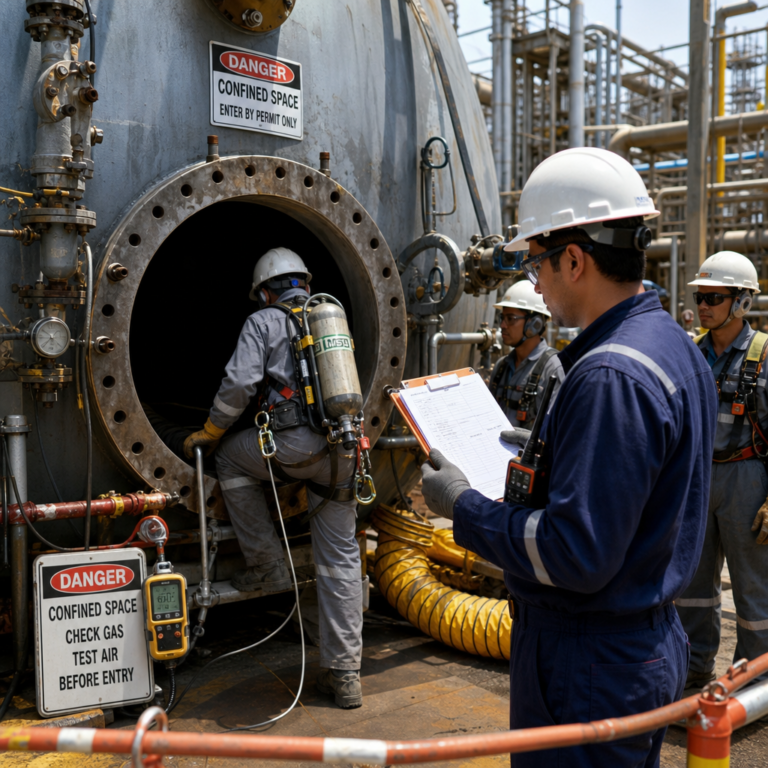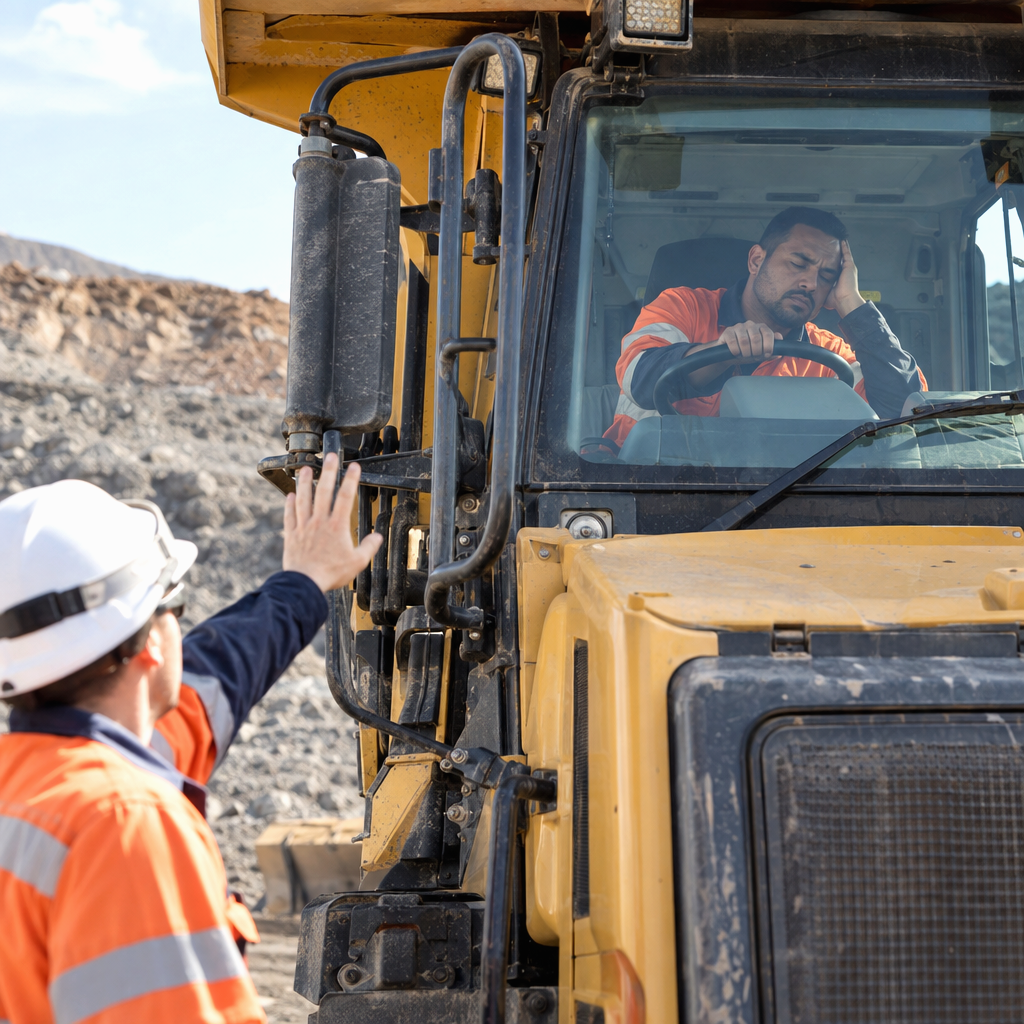
A permit can be correctly completed. An isolation can be recorded. A supervisor can sign the authorisation. Yet a serious incident can still begin with someone who is physically at work but mentally unready for it.
In heavy industry, cognitive fitness for work matters as much as physical access control, competence records and personal protective equipment. Fatigue, illness, alcohol or drug impairment, stress and distraction can weaken judgement at exactly the point where a person must recognise a changing condition, challenge an unsafe assumption or stop a job.
Technology can help identify those warning signs. It must never become an excuse for employees, supervisors or organisations to abdicate their own safety responsibilities to a system.
Safety depends on people being present in mind as well as body
Mining, energy, manufacturing and oil and gas operations all rely on people making sound decisions under real operating pressure. The work may involve mobile equipment, stored energy, hazardous substances, confined spaces, electrical systems, lifting operations or simultaneous operations.
A person may have completed the relevant training. They may hold the required authorisation. They may have performed the task many times before.
None of this guarantees that they are mentally ready to work safely today.
Cognitive impairment can take many forms, including:
- Fatigue caused by long shifts, poor sleep, overtime, commuting, night work or disrupted rosters.
- Illness or pain, including fever, infection, medication side effects and chronic discomfort that affects concentration.
- Alcohol, drugs or hangovers, whether from prescribed medication, recreational substances or residual impairment after time away from work.
- Stress and personal pressures, such as family difficulties, financial strain, bereavement or conflict.
- Low motivation or disengagement, which can encourage people to rush, take shortcuts or treat safety checks as an administrative burden.
- Heat stress, dehydration or poor nutrition, all of which can affect alertness and decision-making.
- Information overload, particularly during shutdowns, complex maintenance work or rapidly changing plant conditions.
- Complacency and routine, where familiar work is treated as low risk because it has been completed safely many times before.
The uncomfortable reality is that people often do not recognise the effect on their own judgement. Others may notice it but feel unwilling to challenge a colleague, especially where production pressure, hierarchy or workplace culture makes speaking up difficult.
Cognitive fitness for work sits within the hierarchy of controls
The hierarchy of controls provides a useful way to frame the issue. The US National Institute for Occupational Safety and Health (NIOSH) describes five broad control levels:
-
Elimination
Remove the hazard entirely. -
Substitution
Replace the hazard with a less hazardous alternative. -
Engineering controls
Isolate people from hazards through equipment, design or physical safeguards. -
Administrative controls
Change the way people work through procedures, training, scheduling, permits, supervision and rules. -
Personal protective equipment
Protect the individual with equipment such as helmets, gloves, respiratory protection and fall-arrest systems.
The hierarchy matters because the lower levels depend more heavily on consistent human behaviour. A permit-to-work process, a pre-start check, a fatigue declaration or a toolbox talk may all be necessary controls. They are still administrative controls. Their effectiveness depends on people understanding the requirement, engaging with it honestly and applying their judgement properly.
This is one reason why safety systems should aim to remove or reduce hazards wherever possible before relying on paperwork, memory or good intentions.
However, hazardous work cannot always be engineered away. Maintenance must still take place. Isolations must still be verified. Operators must still respond to abnormal conditions. Supervisors must still decide whether a job can proceed safely.
The challenge is therefore to make administrative controls more effective, particularly when a person’s attention or judgement may be degraded.
Why routine safety checks can become ineffective
A safety check that is completed without thought provides little protection.
Paper permits and predictable equivalent electronic forms can encourage a form of procedural autopilot. The same questions appear in the same order. The expected answer is known. A worker may tick boxes quickly because the task is familiar, the shift is busy or the job is late.
This does not necessarily indicate poor intent. It may indicate fatigue, distraction or a process that has become too easy to complete mechanically.
The organisation then has an audit trail showing that a control was completed, but limited evidence that the control was genuinely understood, checked or challenged at the point of work.
This is where cognitive fitness for work needs to be treated as an operational risk rather than a personal failing. The objective is not to punish someone for being tired, unwell or distracted. It is to recognise that their capacity may be reduced and to introduce compensating controls before an error reaches the plant.
Existing methods for identifying impairment
Heavy industry already uses a range of methods to reduce the risk of impaired work. The appropriate combination depends on local legislation, industrial relations requirements, privacy obligations, the nature of the work and the site’s risk profile.
Common approaches include the following:
Fitness-for-work declarations
Employees and contractors may be required to confirm that they are fit for work before entering site or commencing a shift. These declarations can cover fatigue, medication, alcohol, drugs and other conditions that could affect safe performance.
The limitation is obvious: a declaration depends on self-awareness and honesty. It should be part of the process, not the whole process.
Alcohol and drug screening
Many mining and heavy industrial sites conduct alcohol and drug testing before site access, after incidents, randomly, or where reasonable suspicion exists. This is particularly relevant where people will operate haul trucks, mobile plant, cranes, locomotives or other high-consequence equipment.
Testing can identify an important category of impairment. It does not identify fatigue, stress, distraction, illness, poor judgement or lack of attention to a specific task. It must therefore sit alongside other administrative and supervisory controls.
Fatigue management programmes
Fatigue management commonly includes roster design, maximum working-hour rules, overtime controls, rest-period requirements, journey management, fatigue reporting and training for supervisors.
These programmes address known contributors to fatigue. They do not guarantee that an individual has slept adequately, is alert after a difficult night, or is able to concentrate during a complex permit authorisation.
Supervisor observation and intervention
Experienced supervisors often recognise when someone is unwell, distracted or behaving differently. A short conversation, a change of duties, additional supervision or removal from high-risk work can prevent a poor decision from becoming an incident.
This relies on supervisors having the time, confidence and authority to intervene. It also depends on a workplace culture where people can report concerns without being labelled difficult or unreliable.
An environment where people are under production pressure and working long overtime to meet unrealistic targets is not conducive to asking someone to stop work – but it sometimes is necessary. Good supervisors know where to draw the line.
Peer reporting and buddy systems
A strong safety culture encourages colleagues to speak up when they see someone who may not be fit to work. Buddy checks can be valuable, particularly before high-risk tasks, confined-space entry, lifting work or complex isolations.
Peer intervention should be encouraged and protected. The consequences of a serious incident are too severe to rely on informal reporting alone. People may miss the signs, hesitate to intervene or assume somebody else has already acted.
Cognitive fitness checks should be built into critical work processes
Digital systems create opportunities to make safety interactions more meaningful.
A permit initiator can be presented with randomised, task-relevant questions during permit planning. The questions can test understanding of the work scope, key hazards, isolations, gas-testing requirements, simultaneous operations or emergency arrangements. Randomisation helps prevent people from learning a sequence of expected answers.
Where an answer is incorrect, incomplete or inconsistent with the planned work, the system can require clarification, provide an additional check or direct the person to involve a competent supervisor.
IntelliPERMIT supports such configurable tests within the permit wizard used to plan and execute a permit to work. These checks can also be applied during authorisation and sign-off stages by other role-players.
The purpose is simple: create evidence that people have engaged properly with the critical controls, rather than merely progressed through a workflow.
From isolation verification to intelligent prompts
Permit authorisers and signatories carry a particular responsibility. Their confirmation often allows hazardous work to begin or continue.
Digital validation can strengthen this stage in several ways:
- RFID or barcode checks can confirm that an individual has physically verified a specified isolation point or tagged asset.
- Mandatory field validation can prevent a permit from progressing until key details are completed.
- Role-based authorisation can ensure that only competent, authorised people approve defined parts of the workflow.
- Time-based indicators can flag forms completed unusually quickly, particularly where a complex task normally requires careful review.
- Response-pattern indicators can identify repeated failed answers, extended hesitation, unusual changes in response behaviour or other signals that may warrant a further check.
- Escalation workflows can require a supervisor review, a repeat verification or additional task-specific questions before work proceeds.
An AI-enabled agent could use these signals to identify circumstances where an individual may not be applying full cognitive attention. It should not diagnose fatigue, illness or impairment. Nor should it make an unchallengeable decision about a person.
Its role is to flag risk, apply carefully defined rules and introduce proportionate verification. A supervisor or other authorised person remains accountable for the decision.
For example, a system may require an additional isolation check where an authoriser has answered a critical question incorrectly, completed an unusually complex approval sequence in an implausibly short time, or shown a pattern that differs materially from their normal use. Depending on the site rules, the outcome could range from a simple prompt to a formal review, reassignment of the task or disallowing the work from proceeding.
The logic requires careful design. The rules must be aligned to the site’s safe-work procedures, tested with operational teams and reviewed for fairness, privacy and practical effectiveness. Poorly configured challenges will frustrate competent people and may teach users to work around the system.
Permit-to-work systems do not cover every exposure
Permit controls are powerful, but they have limits.
Much routine operational work is not performed under a permit to work. An operator can arrive for routine shift, take control of heavy equipment, monitor a process plant or respond to alarms without a permit being required.
The same cognitive risks still apply.
This is where structured shift handover and operational processes become important. FlexiLOG shift handover processes, for example, can include checks and prompts that help identify concerns about an incoming shift’s readiness, the completeness of operational information or changes that require explicit attention.
The principle can apply to any meaningful interaction with IntelliPERMIT or FlexiLOG: a shift handover, a routine inspection, a control-room acknowledgement, a pre-start process or a critical operational checklist.
A well-designed system can prompt, test, record and escalate. It cannot substitute for competent leadership, sound rostering, workplace support or an open reporting culture.
Building a practical cognitive fitness for work programme
Operations and safety leaders can begin with a structured review of the points at which people enter, take over or perform high-risk work.
1. Map every route into hazardous work
Consider every way an individual may enter the plant or begin work:
- Site access and contractor induction
- Shift start and control-room handover
- Mobile-equipment allocation
- Permit initiation and acceptance
- Permit authorisation and isolation verification
- Toolbox talks and pre-start meetings
- High-risk task execution
- Shift relief and end-of-shift handover
For each point, ask whether the organisation has a credible way to identify someone who may be unfit to continue.
2. Catalogue the existing controls
List the controls already in place, including:
- Alcohol and drug testing
- Fatigue-management rules
- Rostering and overtime controls
- Medical and occupational-health processes
- Supervisor observations
- Peer reporting arrangements
- Permit-to-work requirements
- Competency and authorisation records
- Shift handover procedures
- Digital workflows and audit trails
Then assess where adequate controls exist and if they rely entirely on a person remembering, declaring or recognising their own reduced capacity.
3. Focus on the highest-consequence decisions
Do not add complex checks everywhere simply because the technology allows it. Start where an error could expose people to stored energy, hazardous substances, moving equipment, confined spaces, work at height or unsafe simultaneous operations.
The checks should match the risk. A minor routine activity may need a simple confirmation. A complex electrical isolation or confined-space entry may justify stronger verification and supervisory review.
4. Make escalation clear and supportive
People need to understand what happens when a concern is raised. The process should support early reporting, allow a supervisor to assess the situation and provide alternatives where possible, such as reassignment, rest, transport home or additional supervision.
A programme that is experienced only as surveillance will drive problems underground.
5. Do not rely on training alone
Training and re-training remains necessary. But it does not make people immune to fatigue, pressure or distraction. Even highly competent employees can make poor decisions when they are not fully present.
The stronger approach combines competent people, a supportive culture, engineered safeguards, clear procedures and digital controls that make critical safety interactions harder to complete on autopilot.
Technology should reinforce judgement, not replace it
The aim is not to create a workplace where software decides who is safe. The aim is to identify situations where the normal defences may be weakened and to ensure that the right people pause, verify and make a conscious decision.
A permit system should never become a mechanism for transferring responsibility from the person doing the work to the person who configured the software. It should make responsibility more visible, more deliberate and easier to audit.
For organisations seeking to strengthen cognitive fitness checks within control-of-work, permit-to-work and shift-handover processes, Adapt IT Heavy Industries can help assess where technology can provide useful additional controls. IntelliPERMIT and FlexiLOG are proven solutions that can support configurable challenges, verification steps and auditable escalation workflows that complement existing fatigue, substance-testing, supervision and safety-culture programmes.
Contact Adapt IT to discuss how these techniques can be applied to your site’s operating model and safe-work procedures.