
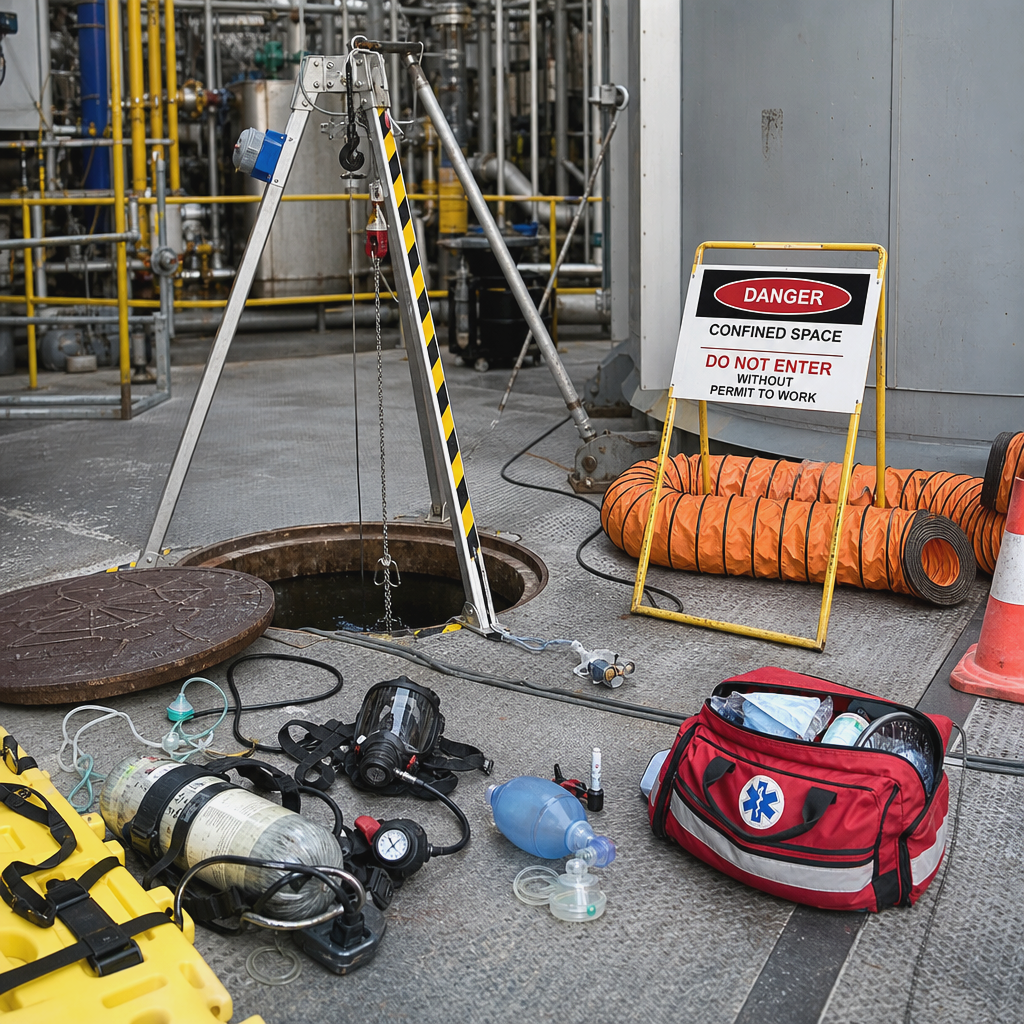
A confined space emergency develops quickly. The rescue plan cannot be sitting in a filing cabinet, stored in an old shared drive, or known only to one supervisor.
When people enter a manhole, process vessel, tank, flocculation structure or other restricted space, operations management must be able to show that the work was properly assessed, authorised and controlled. More importantly, the people at the job must know what to do if conditions deteriorate.
A confined space permit is a central part of that control. It brings together the work scope, hazards, isolations, gas-testing requirements, authorisations and precautions needed before entry is allowed. Yet the permit alone does not make the work safe. It must be supported by practical, location-specific emergency arrangements.
A properly controlled rescue plan is an essential control measure for confined space entry.
Why confined space work requires a rescue plan
Confined spaces create a combination of risks that can escalate with little warning. Atmospheric conditions can change. A worker may be overcome by gas, heat, fumes or lack of oxygen. Access and egress may be difficult. In some locations, a person cannot be removed without specialised equipment and trained rescue personnel.
For this reason, most industrial sites require specific additional controls before a confined space permit can be issued. These commonly include:
- Gas testing before entry, and sometimes continuous monitoring during the work
- Isolation of energy sources, process fluids and hazardous materials
- Confirmation that the atmosphere is safe for the planned work
- Suitable ventilation and lighting
- Communication arrangements between personnel inside and outside the space
- A designated standby person, often referred to as a hole watch
- A trained rescue team with the necessary equipment, including breathing apparatus where required
- A documented rescue and emergency extraction procedure
The precise requirements will differ between mines, process plants, oil and gas facilities, power stations and manufacturing sites. The principle remains the same: emergency response must be planned before entry, not improvised during an incident.
A hole watch, for example, has a defined safety role. They remain outside the confined space, monitor the work and maintain communication with people inside. If an emergency occurs, they initiate the agreed response. They should not enter the space to attempt an unplanned rescue, because this can create additional casualties.
The rescue procedure must therefore be clear, accessible and suited to the location.
A rescue plan needs to be available at the point of work
Many operations have sound rescue procedures on paper. The weakness appears when the document is difficult to locate, out of date, generic, or disconnected from the permit under which the work is being performed.
A rescue plan for a deep manhole may require different equipment, access arrangements and recovery methods from one for a vessel, sump, clarifier floc or underground structure. A generic confined space procedure may set the overall standard, but it cannot always give workers the detail required for a particular location.
People at the work site need access to the correct plan when the permit is being prepared and when the work is underway. Supervisors, safety personnel and emergency responders also need confidence that they are using the current approved procedure.
This is a control-of-work issue as much as a document-management issue. If the rescue plan is detached from the permit process, there is more opportunity for the wrong procedure to be selected, an outdated document to be printed, or an essential step to be missed.
Linking rescue plans directly to the confined space permit
IntelliPERMIT is designed to support site-specific permit-to-work processes rather than forcing an operation into a generic workflow. Permit types, terminology, authorisations, roles and approval steps can be configured to reflect the way a particular site manages high-risk work.
The platform can also be extended through FlexiLOG templates.
For confined space work, this means an approved emergency rescue plan can be created, controlled and maintained in FlexiLOG, then selected and embedded directly into the relevant electronic permit-to-work workflow. The rescue plan becomes part of the information package used to authorise and execute the work.
This approach gives safety teams a practical way to connect standard operating procedures with the live permit process.
Instead of asking supervisors to find the right rescue document separately, the system can require them to select an approved plan as part of the confined space permit. The permit workflow can prevent the process from moving forward until the required rescue plan has been selected.
For a Safety and Health Manager, this creates stronger assurance that high-risk work is being authorised with the relevant emergency controls in place.
FlexiLOG Rescue Plan Module is available in IntelliPERMIT Version 11
The FlexiLOG Rescue Plan Module, available in IntelliPERMIT version 11, provides a template-based method for authoring and managing rescue procedures for specific high-risk locations.
Safety teams can prepare standard rescue plans for asset classes and work areas such as:
- Manholes
- Process vessels
- Clarifier flocs
- Tanks and sumps
- Restricted-access structures
- Other confined or difficult-to-access locations
Each rescue plan can include the written response sequence, supporting photographs, equipment diagrams and access information needed by the people conducting or supervising the work.
Asset-specific rescue plan selection
Rescue procedures can be categorised by asset class or location type. This helps field teams select a plan that applies to the actual work area rather than working through a long library of unrelated documents.
A worker entering a manhole requires a different response plan from a contractor working in a process vessel. Making this distinction during permit preparation reduces ambiguity at a point where clarity matters.
Structured rescue procedures with visual information
Written instructions are necessary, but they are often easier to apply when supported by clear visual material. The Rescue Plan Module provides fields for site photographs, equipment schematics and access diagrams.
These may show:
- Entry and exit points
- Recovery routes
- Anchor points and lifting arrangements
- Rescue equipment locations
- Emergency assembly or access areas
- Obstructions or restrictions that affect extraction
The rescue sequence can be written as a clear chronological procedure, with visual information placed alongside the relevant instructions. This is useful for both experienced rescue teams and personnel who need to understand their role before work starts.
Automatically compiled, print-ready documentation
The system can compile the approved rescue-plan content into a single document containing the written instructions and associated images. The document is formatted to be legible when printed alongside the active permit, where site practice requires hard-copy documentation at the work location.
This supports a practical field requirement. People should not need to assemble a rescue pack manually from several folders, photographs and procedure documents while preparing a confined space permit.
Controlled templates for consistent execution
A rescue plan must be current and approved. FlexiLOG templates provide version control so that updates to a rescue sequence, diagram or equipment requirement are reflected in future permits using that template.
This gives safety teams a clearer way to standardise emergency arrangements across shifts, contractors and work areas. It also provides a better audit trail when reviewing whether the right controls were in place for a particular job.
Better control of work starts before entry
Confined space safety depends on disciplined preparation. Gas testing, isolation, standby arrangements and rescue readiness are all part of the same control-of-work process.
Digital permit-to-work systems help when they make those controls easier to apply consistently in the field. Linking an approved, asset-specific rescue plan to the confined space permit gives teams direct access to the emergency information they need before work begins.
For mining operations and other high-risk industrial sites, this supports stronger compliance, clearer accountability and better preparedness for the events nobody wants to face.
Contact IntelliPERMIT to learn more about the FlexiLOG Rescue Plan Module in version 11, or to arrange a demonstration.


