
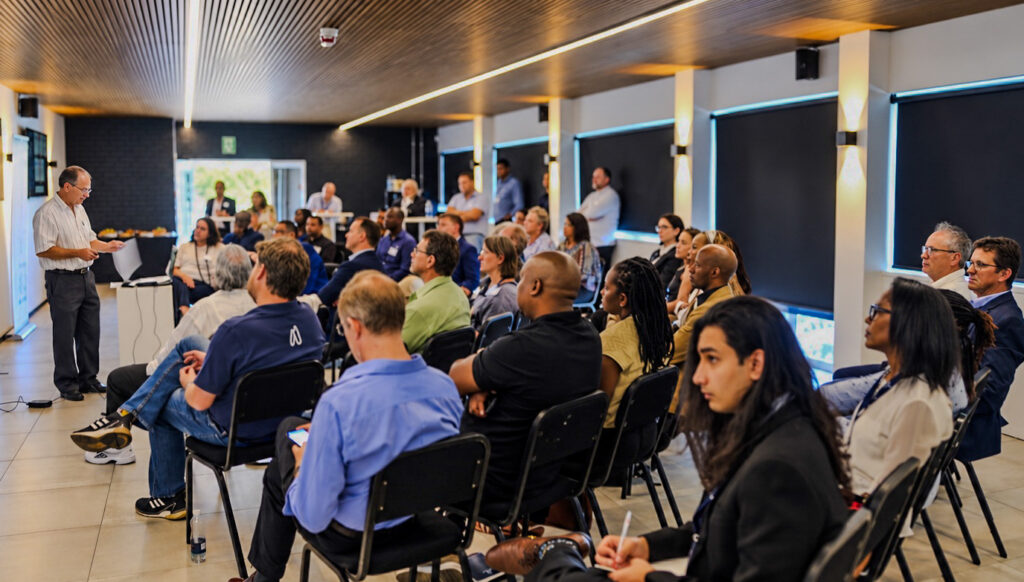
On 20 October 2026, IntelliPERMIT, RSPH and AlertMeter by Predictive Safety brought together operational leaders, safety professionals and technology experts for the Industrial Safety Forum at The Tryst in Kramerville, Sandton.
The event focused on a difficult question for South Africa’s mining and industrial sectors: how do organisations close the gap between compliance and control?
A signed-off permit does not, by itself, make a worksite safe. The real test comes when people, processes and technology work together to identify risk, challenge assumptions and control the work in front of them.
An engaged room, ready to act
The room was full of people asking questions, taking notes, sharing experiences and considering how to apply the ideas discussed.
That matters. Attending a safety event is easy. Leaving prepared to change something in the workplace takes more commitment.
The forum brought together people from across the operation, including:
- Operations
- Safety
- Engineering and Maintenance
- Control of Work
- Technology and Digital
- Human Performance
- Executive leadership
Safety does not belong to one department. It depends on the quality of cooperation across the entire operation.
Moving beyond compliance
The forum challenged the assumption that compliance is the same as control.
Compliance provides a framework. Control depends on how that framework is applied in real conditions, under real operational pressure, by people who may be dealing with changing information, competing priorities and imperfect communication.
The discussion returned repeatedly to accountability. Who owns the risk? Who has the authority to stop the work? Who confirms that the controls are in place? What happens when conditions change?
These questions are uncomfortable, but they are necessary.
Different perspectives, practical ideas
The speakers brought experience from operational risk, safety leadership, human performance, technology and organisational culture.
Dilley Naidoo, RSPH
Dilley Naidoo, Chief Vision Officer at RSPH, challenged organisations to move beyond complacency and align people, process and technology around operational excellence.
With more than 50 years of experience, Dilley brought a long-term perspective to the discussion. Strong safety performance requires more than procedures. It requires organisations to examine how work is actually done and whether the systems supporting that work are fit for purpose.
Scott Bredin, Adapt IT
Scott Bredin, Divisional Executive for Heavy Industries at Adapt IT, examined the role of technology in addressing cognitive bias.
With 25 years of experience in operational risk and Control of Work, Scott focused on the need for practical control across permits, isolations and handovers. Good intentions are valuable, but high-consequence work also needs systems that help people identify conflicts, verify critical information and make sound decisions.
Dionne Kerr-Malherbe, Siyakha Consulting
Dionne Kerr-Malherbe, Founder and CEO of Siyakha Consulting, explored the relationship between diversity, culture and safety in the future workplace.
Her experience across public and private-sector organisations provided a useful reminder that safety culture is shaped by how people are treated, heard and supported. An organisation cannot build trust whilst ignoring the different experiences and perspectives within its workforce.
Shandray Ramsamy, Predictive Safety Africa
Shandray Ramsamy, Regional General Manager for Fatigue Management at Predictive Safety Africa, addressed human readiness intelligence.
Someone can be physically present at work without being mentally ready to perform safely. Fatigue, stress and other factors can affect judgement, attention and reaction time.
The earlier organisations identify those risks, the more opportunity they have to act before an incident occurs.
Henry Boshoff, Adapt IT
Henry Boshoff addressed the growing role of artificial intelligence in industrial safety.
AI can help organisations bring together information from across the operation, identify potential conflicts and highlight weak signals before work begins. It can support better decisions by making relevant information easier to find and interpret.
The decision-maker must remain accountable.
In hazardous industries, AI should support human judgement, not replace it. The value of the technology depends on how well it improves understanding, strengthens control and helps people act on reliable information.
Client experiences and what comes next
The programme included a discussion of what changes when safety systems are applied in the workplace rather than discussed only in policy documents.
The forum also covered:
- IntelliPERMIT’s AI philosophy
- Cognitive state monitoring with AlertMeter
- Human factors and safety
- The human-machine interface is actually part of a much larger support system
These subjects are connected by a common challenge: how can organisations give people the information, tools and authority they need to control work safely?
Safety is about people
Every safety statistic represents a person.
Someone’s parent, partner, child, friend or colleague. Someone who should return home safely at the end of every shift.
People, processes and technology all matter. Lasting improvement also requires leadership, accountability and the willingness to turn knowledge into action. It requires people to admit when a control is weak, when a process is not working or when an assumption needs to be challenged.
No organisation has every answer. Progress depends on collaboration.
The conversation continues
The value of an event is measured by what happens after it ends.
What will change in the workplace because of these discussions? Which risk will receive greater attention? Which assumption will be tested? Which conversation will begin?
The energy in the room needs to continue through everyday decisions, planning meetings, permit reviews, handovers and frontline conversations.
One life lost is one too many.
Zero Harm. Zero Excuses.
Real conversations. Practical solutions. A safer tomorrow.


